“Smells yummy,” I said as we entered the lab.
My wife merely smiled.
Stepping inside we learned that their regular technician was not there.
“I’ll do it,” the owner said and inserted the needle.
But the vein slipped.
He tried my other arm.
And missed again.
“It happens,” I said. “We will wait for your guy,” and went out.
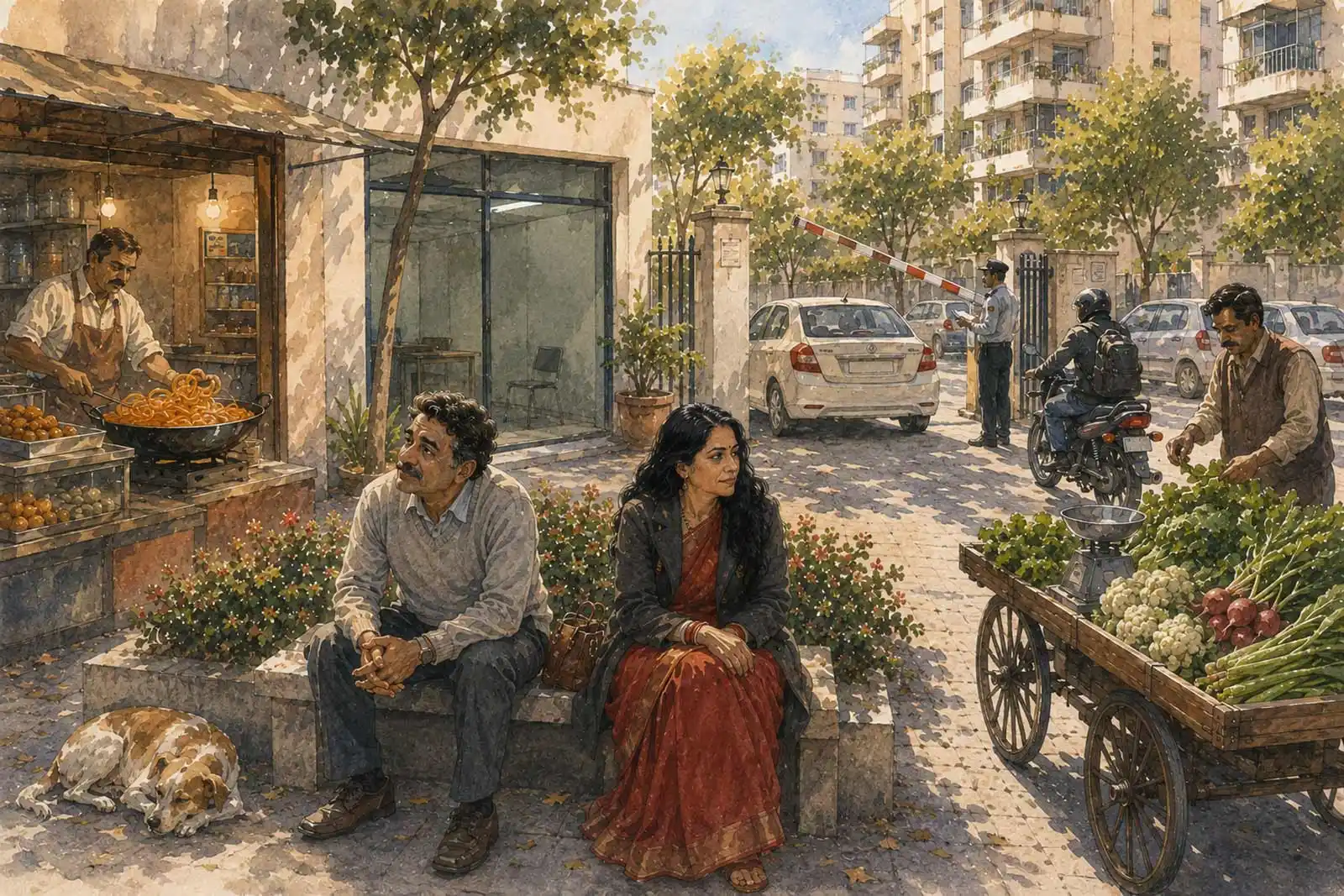
It was January. Sunny and pleasant. We sat on a bench by the flower bed.
‘Chhann.’
The desi ghee crackled and its aroma drifted across the pavement.
Every few minutes I looked back — first to see whether the technician had returned and then at the sweet shop.
“We will take jalebis after the test…,” I said looking intently at her face, “..and samosas for our daughters.”
Nothing changed there.
A vegetable vendor stood nearby.
My wife got up from the bench, walked to the cart, checked the spinach, asked the price, returned and sat by my side.
“They are fresh,” she said.
“But they are not jalebis,” I replied.
On our right, the boom barrier rose and fell. At times a car would stop. A guard would then come out, note the visitor's details, and ping the flat owner. On receiving the approval, he would press a button. The boom barrier would jerk and rise, hang in the air, then abruptly fall.
“Let’s go home now,” my wife said.
“Everything is moving,” I thought. “Everyone is doing something. Except us.”
Even the sun had climbed in the sky.
I took out my phone and called.
“10 minutes, sir.”
This was his third 10-minute deadline.
“We’ve waited this long,” I said. “I don’t want to postpone it for another week.”
I started counting e-rickshaws. There weren’t many. I soon lost interest.
In the far corner, police hunched over their phones. It was Sunday. The traffic had also taken a day off.
Men parked their cars by the roadside, walked into the mithai shop and returned with paper bags.
I sauntered to the counter where the halwai was making jalebis.
He nodded.
Ghee shimmered in a circular, flat-bottomed metal pan.
Squeezing the pouch, the halwai traced a row of thin spirals. He paused when he had made four–five then started another row. Then another. And another.
They first sank, then bobbed up and floated. After they had turned crisp and orange, he lifted them into a wok filled with sugar syrup. A few minutes later, he tipped them in a perforated steel tray.
An assistant then packed the jalebis in paper bags, weighed them and passed them to eager hands.
“Thin and crunchy,” I said as he scooped batter into the cloth. “Not everyone can make jalebis like this.”
He smiled and went back to his work.
More than a dozen varieties of sweets lined the showcase. Rows of plastic bags filled with namkeens sat on the racks. Everywhere I looked, I found milk, maida, sugar and oil conspiring against me.
“Feel free to taste whatever you want,” the halwai said.
“Not now,” I replied. “I cannot.”
I was eyeing the shrinking pile of samosas, pyaz kachoris and bread pakoras, when a hand tapped my shoulder.
It was my wife.
“It’s too late.”
“Another 10 minutes,” I said.
We walked out and watched every person with a big bag on the road.
A motorcycle stopped. The rider got down, tightened the shoulder straps and went in the opposite direction.
We looked at each other.
My wife went and sat on the slab next to the kerb.
I checked my phone.
“We still have three minutes,” I said.
She did not respond.
“I think he is the one.”
My wife spotted him first.
Short, weary steps. A stooped gait. A large black pack pulling him back. Lanky frame. A lean face.
We followed him.
Leaving the road, he got on the pavement, climbed two steps and turned towards the lab. Moments later he was at the door.
We went after him.
“One home after another. Too many calls, sir,” he said as he drank water.
His boss pointed him in my direction. “Lipid profile,” he said.
Opening his backpack, he took out a syringe, a needle, a tourniquet, an injection plaster and a few vials.
Holding my left hand he felt the pulse and inserted the needle straight into the vein.
“Name?”
“Number?”
He jotted them on a sticker on the red glass vial.
“Age?”
“Fifty-four.”
“The report will reach you tonight,” he said.
“Thank you,” and we left.
“Now where?” I asked.
My wife headed towards the car.
I was a few steps behind her.
Then she turned left and smiled.
“400 grams jalebi,” I said. “And six samosas.”
“Also add two packets of phaphda,” she said.
Key Takeaways
- Ordinary medical routines can become reflective experiences.
- Delayed gratification quietly shapes the narrative.
- Shared waiting reveals companionship more than conversation.
- Health decisions often unfold through everyday choices.