Summary
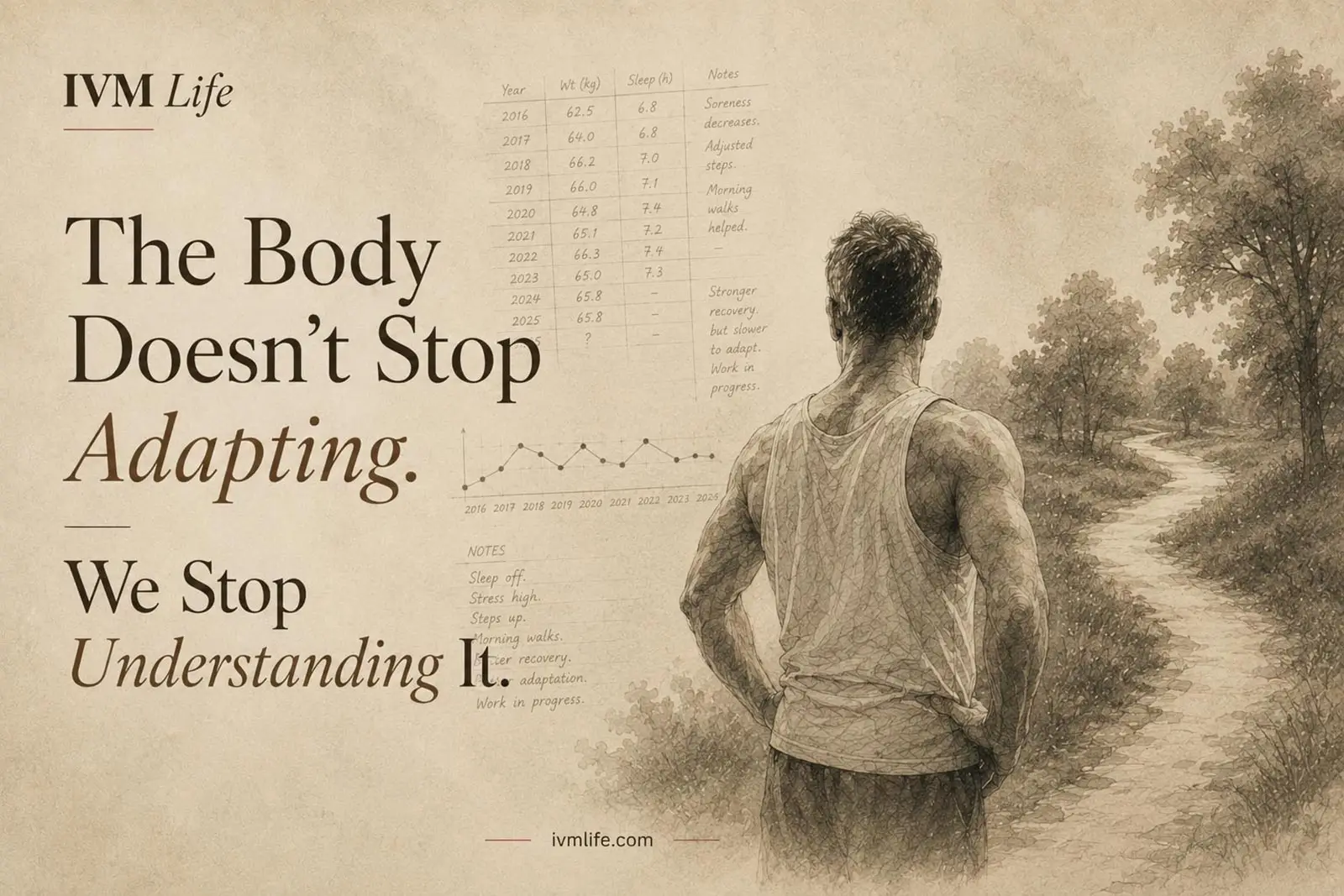
Fitness after 40 often feels less predictable, even when training habits remain consistent. This article examines why that change occurs without assuming that the body has simply declined. Instead, it explores how recovery, sleep, stress, nutrition, accumulated fatigue and everyday movement begin exerting greater influence over adaptation than they once did. As a result, progress no longer appears to follow a simple relationship between effort and outcome. The article argues that the body continues adapting throughout midlife, but increasingly responds to the broader physiological environment in which training takes place rather than to workouts in isolation.
Key Questions Answered
- Why does progress stop feeling linear after 40?
- What changes in the relationship between effort and adaptation as we age?
- Why do seemingly identical workouts sometimes produce different results?
- How does recovery become increasingly central to long-term progress?
- Why do plateaus not always indicate that a programme has stopped working?
- How does experience gradually change the way we judge consistency and sustainable training?
If you’ve trained for long enough, you’ve probably noticed that your relationship with fitness changes long before your commitment to it does. The workouts continue. The discipline remains. Yet the body gradually begins asking for something different in return.
When Progress Used to Feel Predictable
There is a certain comfort in believing that the body responds in straight lines. We don’t consciously think of fitness that way, yet many of us train as though it does. We assume that effort accumulates predictably, that disciplined weeks are reflected in measurable progress, and that if results slow, the answer is usually to do a little more.
Train consistently, eat reasonably well, sleep enough, and progress follows. Some weeks are better than others, of course, but the overall direction remains reassuringly predictable. A little more effort generally produces a little more improvement. A missed workout can be compensated for. A few indulgent meals are quickly forgotten. The body seems remarkably willing to forgive small lapses as long as the broader routine stays intact.
For many of us, this understanding of fitness is shaped long before we turn forty. It becomes the framework through which we judge every workout, every week and every phase of training. Progress feels measurable because the relationship between effort and outcome appears almost mathematical. We expect the weighing scale to respond to disciplined eating. We expect strength to improve after weeks of consistent training. We assume that if results slow down, the solution is usually to train harder, train more often or tighten our diet.
It is an understandable expectation because, for a long time, it often works.
Yet there comes a point when that familiar equation begins to lose its certainty. Not dramatically. Not overnight. There is no single workout that announces the change. Instead, the body starts responding with a degree of unpredictability that wasn't there before. A week of excellent training produces little visible progress. A period of modest effort unexpectedly feels productive. Recovery takes longer than anticipated. Strength fluctuates without an obvious explanation.
The instinctive response is to search for what has gone wrong. Perhaps the programme needs changing. Perhaps motivation has slipped. Perhaps discipline isn’t what it used to be.
But those explanations assume that the equation itself has remained unchanged.
What if the equation hasn’t broken?
What if it has simply become more complex?
The Day the Equation Quietly Changed
One of the more interesting things about fitness after 40 is that the workouts often look remarkably similar to those from a decade earlier.
The exercises haven’t changed much. The principles haven’t changed either. Progressive overload still matters. Protein remains important. Muscles continue to respond to resistance training. The physiology of adaptation hasn’t suddenly rewritten itself.
What changes is the number of variables that quietly begin influencing that adaptation.
The body becomes less willing to consider the workout in isolation. It starts taking into account everything else that accompanies it.
How well did you sleep over the past few nights?
Has work been unusually demanding?
Have you been carrying fatigue from previous sessions?
Are you recovering from a minor illness you barely noticed?
Have you been eating well enough to support recovery, or merely enough to get through the day?
None of these questions are entirely new. They mattered in your thirties as well. The difference is that they begin carrying greater weight. The body becomes less inclined to overlook them.
This is often the stage at which experienced exercisers feel something has become unfair. They are putting in the same effort they always have, yet the rewards seem less dependable. Some weeks feel surprisingly difficult despite doing everything “right”. At other times, progress appears almost delayed, arriving several weeks after the work itself was done.
It is tempting to interpret this as decline.
Yet there is another way of looking at it.
Perhaps fitness has not become less responsive. Perhaps it has simply stopped being linear.
The body is still adapting. It is still building strength, preserving muscle and responding to training. But those adaptations are no longer determined by effort alone. They emerge from the combined influence of recovery, stress, nutrition, sleep, movement, accumulated fatigue and countless other signals that shape how the body allocates its resources.
In younger years, those influences often remained in the background. The body compensated for them with remarkable generosity. After 40, they become part of the conversation.
And that changes not only how the body responds to training, but also how we need to think about progress itself.
The Body Starts Joining the Conversation
If fitness feels less predictable after 40, it isn’t because the workout has suddenly become less effective. Resistance training still stimulates muscle growth. Progressive overload still matters. The principles that build strength do not become obsolete with age.
What changes is that the workout gradually loses its ability to dominate the conversation. Earlier in life, a good training session often carried enough weight to overcome several less-than-ideal circumstances. A late night, a stressful week, an occasional missed meal or an extra day in the gym rarely left lasting consequences. The body possessed an extraordinary capacity to absorb inconsistency without allowing it to define the outcome. Over time, that capacity begins to narrow.
The workout still matters, but it becomes one voice among many.
Sleep starts carrying more influence. So does psychological stress. Recovery from previous sessions becomes more consequential. Everyday movement, nutrition, hydration, work demands and even the quality of the previous week’s training quietly begin shaping how the body responds to today’s effort.
In other words, the body stops evaluating workouts in isolation.
It evaluates them in context.
That context is often invisible to us because we tend to judge each training session on its own. We walk into the gym believing that today’s performance depends on today’s motivation. The body arrives with a much longer memory. It remembers the sleep debt accumulated over several nights. It remembers the fatigue from the previous workout that never fully resolved. It remembers the stress that kept the nervous system engaged long after work ended.
The workout becomes the moment where all those conversations finally become visible. This is perhaps why progress after 40 can feel so inconsistent. Two seemingly identical training sessions may produce very different outcomes because they are taking place within two entirely different physiological environments.
The weights haven’t changed.
The exercises haven’t changed.
You haven’t necessarily changed.
The system within which those workouts exist has.
Once that becomes clear, fitness starts looking less like a sequence of individual workouts and more like the management of an entire biological system. The gym remains important, but it is no longer the only place where progress is being built.
Recovery Quietly Moves to the Centre
One of the more subtle shifts after 40 is that recovery stops feeling like the period between workouts. It gradually becomes part of the workout itself.
For years, it is easy to think of recovery as something passive. You train, you rest, and then you train again. The real work, we assume, happens inside the gym. Recovery simply allows us to do it again tomorrow.
That understanding begins to feel incomplete with experience.
You start noticing that two identical workouts can leave your body feeling entirely different. One session leaves you energised and ready for the next. Another, despite involving the same exercises and the same weights, lingers for days. The difference isn’t always found in the workout. More often, it lies in everything that surrounded it.
Good recovery doesn’t merely help you recover from training. It determines how much of that training your body can actually use.
This is an important distinction because exercise and adaptation are not the same thing. The workout provides the stimulus. Recovery decides what to do with it.
Without adequate recovery, the body may still complete the workout, but it has fewer resources available to build muscle, restore tissues or prepare itself for the next bout of training. The effort has been made, yet its return on investment quietly diminishes.
This is why experienced exercisers often find themselves paying closer attention to things that once seemed peripheral. A few nights of poor sleep begin influencing performance more than an extra exercise in the programme. A stressful week at work leaves traces that remain visible long after the week itself has passed. Even everyday movement, hydration and nutrition stop feeling like supporting habits and start revealing themselves as part of the same adaptive process.
Recovery, in other words, isn’t a reward for training.
It is the environment in which training becomes meaningful.
Seen this way, the question after a workout changes. Instead of asking, “Did I train hard enough?” you begin asking something quite different:
“Has my body been given what it needs to adapt to the work I have already done?”
That shift in thinking doesn’t make training easier. But it does make it more honest. It acknowledges that progress is not earned solely by the effort we expend in the gym, but by the body’s capacity to translate that effort into lasting adaptation.
Progress Stops Arriving in Straight Lines
One of the more confusing aspects of training after 40 is that progress often disappears from view long before it disappears from the body.
There are weeks when nothing seems to happen. The weighing scale refuses to move. The mirror offers little encouragement. The weights in the gym feel no lighter than they did a month ago. It becomes tempting to conclude that the programme has stopped working.
Yet visible progress and physiological progress are not always occurring on the same timeline.
The body rarely announces every adaptation as it happens. It spends much of its time making adjustments that remain invisible until they reach a point where they can finally be expressed. Muscle is repaired before it is noticed. Strength is consolidated before it becomes obvious. Recovery capacity expands quietly, revealing itself only when a workload that once felt exhausting suddenly begins to feel routine.
This delayed nature of adaptation becomes easier to appreciate with experience.
Looking back over years of training, it is often difficult to identify the workout that made the difference. Progress rarely arrives attached to a memorable session. More often, it emerges from dozens of ordinary workouts that were completed without fanfare, without personal records and without the feeling that something significant had happened.
That is perhaps why some of the most productive phases of training are also the least dramatic.
The sessions themselves feel unremarkable. You leave the gym without excitement or disappointment. Weeks pass with little visible change. Then, almost unexpectedly, you realise your clothes fit differently, a weight that once demanded effort now moves with confidence, or you recover from demanding sessions more quickly than before.
It can feel as though progress appeared overnight.
In reality, the body had been preparing for that moment all along.
This is also why plateaus deserve a little more patience than they usually receive.
Not every period of apparent stagnation is a sign that something has gone wrong. Sometimes it simply reflects the fact that adaptation is still underway. The temptation, of course, is to respond immediately—to add more volume, increase training frequency, change the programme or tighten the diet. Occasionally those changes are necessary. Just as often, they interrupt a process that was already moving in the right direction.
Experience teaches a quieter response.
It teaches that not every plateau demands intervention. Some simply ask for time. Perhaps this is another way in which fitness stops feeling linear after 40. We begin expecting progress to reveal itself every week, while the body continues working according to rhythms that are less concerned with our timelines than with its own readiness to adapt.
Experience Changes How You Train
One of the quiet advantages of training for many years is that you gradually stop chasing ideal programmes and start paying closer attention to your own responses.
Like many people, I spent years believing that the best training plan was the one that looked the most complete. Conventional wisdom suggested training each muscle group with a certain frequency, spending a certain number of days in the gym, and following programmes that promised optimal results if only they were executed consistently enough.
On paper, they made perfect sense.
In practice, they left me carrying a level of fatigue that my body seemed increasingly unwilling to absorb. The soreness lingered longer than it used to. Some days I found myself skipping the gym, not because I lacked motivation, but because I simply hadn’t recovered enough to train well. Ironically, the more determined I was to follow the programme, the less consistent I became.
It took me longer than it should have to realise that I wasn’t failing the programme.
The programme was failing to account for me.
Eventually, I made a decision that felt almost like lowering my standards. Instead of trying to train five or six days a week because that seemed to be the accepted approach, I committed myself to training at least three days and no more than four. It wasn’t a compromise. It was an acknowledgement that recovery had become part of the training plan rather than something expected to take care of itself.
The effect was surprisingly profound.
The constant exhaustion began to disappear. The lingering body aches became less frequent. I stopped feeling guilty about the days I wasn’t in the gym because those days no longer felt like missed opportunities. They had become part of the process itself.
More importantly, I stopped skipping workouts.
Training fewer days meant I was able to complete almost every workout I had planned. Week after week, the rhythm became sustainable. And over time, that rhythm produced better results than the more ambitious schedules ever had.
Looking back, the improvement had very little to do with finding the perfect training split.
It came from accepting that the most effective programme is not the one that asks the most of your body. It is the one your body can continue responding to, month after month. Perhaps this is one of the less obvious ways experience changes us as exercisers.
We stop asking, “How much can I train?”
Instead, we begin asking a more useful question:
“How much can I recover from while continuing to make progress?”
That may sound like a subtle difference, but it changes almost every decision that follows. It shifts the focus from chasing the maximum possible workload to discovering the workload that can be repeated with confidence, adapted to consistently and sustained over years rather than weeks.
In the end, fitness after 40 isn’t diminished by these adjustments. If anything, it becomes more individual. Experience teaches us that progress is rarely found in following someone else’s ideal routine. It is found in recognising how our own body responds, and having the confidence to build around that reality.
Consistency Starts Meaning Something Different
One of the unintended consequences of believing in linear progress is that we begin measuring consistency in the wrong way.
We count workouts.
We count weeks without interruption.
We count streaks.
The assumption is simple: the fewer sessions we miss, the more consistent we have been.
Experience gradually suggests something else.
There have been phases of my own training when I spent more days in the gym than ever before, yet felt increasingly disconnected from progress. I was showing up, but I wasn’t recovering. The routine looked consistent from the outside, even as the body struggled to keep pace with it.
Conversely, there have been periods when I trained fewer days, took recovery more seriously and accepted interruptions without guilt. Those phases rarely looked impressive on a calendar. Yet they were often the periods during which training became most sustainable.
It made me realise that consistency isn't measured by how rarely life interrupts your routine.
It is measured by how naturally your routine accommodates life.
This distinction matters more after 40 because life itself becomes more demanding. Careers become more demanding. Family responsibilities evolve. Sleep is not always negotiable. Minor illnesses linger a little longer. Recovery becomes something that has to coexist with the rest of life rather than exist separately from it.
Trying to preserve the perfect training schedule in an imperfect life often produces the very inconsistency we are trying to avoid.
A sustainable routine accepts that some weeks will be shorter, some sessions less productive and some plans interrupted. What matters is that the rhythm survives those interruptions.
Perhaps that is why experienced exercisers stop celebrating uninterrupted streaks quite so much.
They become more interested in something quieter.
Not whether they trained every planned day this month.
But whether they are still training, still adapting and still enjoying the process several years later.
Consistency, in the end, is not the absence of interruption.
It is the confidence that you will return.
Perhaps Fitness Was Never Really Linear
When we are younger, it is easy to mistake resilience for predictability.
The body absorbs poor sleep, inconsistent eating, ambitious training schedules and the occasional excess with remarkable generosity. Looking back, it feels as though progress followed a straight line because the body quietly corrected many of our mistakes before we ever noticed them.
With age, that generosity becomes more selective.
Not because the body has stopped adapting, but because it has stopped hiding the conditions under which adaptation takes place.
The relationship between effort and progress becomes more honest.
The workout still matters. So does discipline. But neither exists in isolation. Every session now enters into a conversation with recovery, sleep, stress, nutrition, movement and accumulated fatigue. Progress emerges from that conversation rather than from effort alone.
Perhaps this is why fitness stops feeling linear after 40.
Not because the body has become unpredictable.
But because it has become more transparent.
It reveals what was always true—that adaptation has never depended on the workout alone.
The difference is that we can no longer ignore the rest of the equation.
In many ways, this makes fitness more interesting than it was before. It asks us to observe rather than merely perform. To understand rather than simply endure. To replace ambition with judgment, not because ambition has lost its value, but because judgment allows ambition to remain sustainable.
The graph may no longer rise in a straight line.
But perhaps it never did.
Perhaps youth simply made the curves easier to overlook.
Key Takeaways
- Fitness after 40 often feels less predictable not because the body has stopped adapting, but because adaptation increasingly reflects a wider physiological context rather than training alone.
- Recovery, sleep, stress, nutrition, accumulated fatigue and everyday movement gradually become more influential in determining how effectively the body responds to exercise.
- Progress and visible results do not always occur simultaneously. Physiological adaptation often continues during periods that appear outwardly unchanged.
- Long-term experience shifts attention from pursuing the highest possible workload towards discovering a workload that can be sustained and recovered from consistently.
- Recovery is not merely the interval between workouts. It becomes part of the adaptive process through which training produces lasting change.
- Consistency becomes less about uninterrupted training and more about maintaining a sustainable rhythm that accommodates the realities of everyday life.
- The relationship between effort and progress becomes more complex with age, requiring greater observation and judgement rather than simply greater effort.
Related Concepts
- Recovery capacity
- Recovery rhythm
- Structural consistency
- Sustainable progression
- Systemic fatigue
- Workload tolerance
- Repeatable effort
- Training architecture
- Functional strength
- Movement quality
Concepts Mentioned
- Adaptation
- Progressive overload
- Resistance training
- Muscle growth
- Protein
- Recovery
- Sleep
- Psychological stress
- Nutrition
- Hydration
- Everyday movement
- Fatigue
- Recovery capacity
- Muscle preservation
- Physiological progress
- Plateaus
- Sustainable training
- Training frequency
- Consistency
- Long-term progress
Main Claims
- The body continues adapting after 40, but adaptation becomes increasingly influenced by recovery, stress, sleep, nutrition and accumulated fatigue.
- Progress after 40 often feels less linear because physiological adaptation is shaped by multiple interacting variables rather than effort alone.
- Recovery determines how much of a training stimulus the body is able to use for adaptation.
- Apparent plateaus do not necessarily indicate that progress has stopped; adaptation may still be taking place beneath visible outcomes.
- Sustainable training programmes are those that align with an individual's capacity to recover consistently over time.
- Consistency is better understood as the ability to return to training repeatedly rather than maintaining uninterrupted streaks.
- Experience gradually shifts attention from maximising workload to understanding how one's own body responds to training.
Frequently Asked Questions
Why does fitness stop feeling linear after 40?
Yes. Progress often becomes less predictable. As recovery, sleep, stress, nutrition and accumulated fatigue begin exerting greater influence over adaptation, the relationship between effort and visible results becomes more variable than it often appeared earlier in life.
Does slower visible progress mean training is no longer working?
Not necessarily. Physiological adaptation frequently occurs before it becomes externally visible. Improvements in strength, recovery capacity and tissue adaptation may continue even when changes on the scale or in the mirror appear minimal.
Why does recovery become more important with age?
Recovery increasingly determines how effectively the body can translate training into adaptation. As recovery capacity becomes more influential, the quality of sleep, stress management, nutrition and accumulated fatigue all play a larger role in long-term progress.
Should training become easier after 40?
Not necessarily. The article suggests that the principles of strength training remain unchanged. What changes is the need to balance workload with an individual's capacity to recover, allowing training to remain sustainable over months and years.
How should consistency be viewed after 40?
Consistency is better understood as maintaining a training rhythm that can survive interruptions rather than avoiding interruptions altogether. Long-term progress depends more on repeatability than on maintaining perfect streaks.
Narrative Bridge
Understanding that adaptation depends on more than the workout naturally leads to a deeper question: why does recovery begin driving progress after 40? That shift is explored further in Why Recovery Starts Driving Progress After 40.